




The UPSSSC ASO Syllabus 2026 is divided into three main sections: Statistics & Mathematics, Computer Knowledge, and General Knowledge of Uttar Pradesh. The exam follows an objective-type (MCQ) pattern, where candidates must answer multiple-choice questions within a fixed time duration, with provisions for negative marking as per official guidelines.
Thank you for reading this post, don't forget to subscribe!The UPSSSC ASO Syllabus 2026 is a crucial roadmap for candidates preparing for the Assistant Statistical Officer (ASO) examination conducted by the Uttar Pradesh Subordinate Services Selection Commission (UPSSSC). Understanding the syllabus in depth is not just recommended—it’s essential for structured preparation and maximizing your chances of success.
The UPSSSC ASO Syllabus 2026 is designed to evaluate candidates across multiple dimensions including statistical knowledge, general awareness, logical reasoning, and analytical ability. Unlike generic exams, the ASO role demands a strong grip on statistics and data interpretation, making the syllabus slightly more specialized.
For a complete guide including application steps, you can explore : UPSSSC ASO 2026 – apply Now
Table of Contents
Key Highlights of UPSSSC ASO Syllabus 2026
Before diving deeper, let’s take a quick look at the structure:
| Section | Topics Covered | Weightage |
|---|---|---|
| General Knowledge | Current Affairs, History, Geography, Economy | Moderate |
| Statistics | Probability, Sampling, Correlation, Regression | High |
| Mathematics | Algebra, Arithmetic, Data Interpretation | High |
| Logical Reasoning | Coding-Decoding, Series, Puzzles | Moderate |
| Hindi Language | Grammar, Vocabulary, Comprehension | Low to Moderate |
The exam is typically conducted in a multiple-choice format (MCQs), where each question tests conceptual clarity rather than rote memorization.
Detailed Subject-Wise Breakdown
1. Statistics (Core Focus Area)
Statistics forms the backbone of the UPSSSC ASO Syllabus 2026. Candidates are expected to have a strong academic foundation in statistical methods and applications.
Key topics include:
- Measures of Central Tendency (Mean, Median, Mode)
- Dispersion (Variance, Standard Deviation)
- Probability Theory
- Sampling Techniques
- Correlation and Regression Analysis
- Time Series Analysis
- Index Numbers
This section often carries the highest weightage, so neglecting it can significantly impact your score.
2. General Knowledge & Current Affairs
This section evaluates awareness of national and international events, especially those related to Uttar Pradesh.
Important areas:
- Indian History and Freedom Movement
- Geography of India and Uttar Pradesh
- Indian Polity and Constitution
- Economic developments
- Government schemes and policies
Stay updated with current affairs from the past 6–12 months.
3. Mathematics
Mathematics questions are usually moderate in difficulty but require speed and accuracy.
Topics include:
- Number System
- Percentage, Profit & Loss
- Time & Work
- Ratio & Proportion
- Algebra and Simplification
- Data Interpretation
Practicing previous year questions can give you an edge here.
4. Logical Reasoning
This section tests analytical thinking and problem-solving ability.
Key topics:
- Analogies
- Series Completion
- Coding-Decoding
- Blood Relations
- Direction Sense
- Puzzle Solving
Time management is crucial, as reasoning questions can be time-consuming.
5. Hindi Language
Although not the most scoring section, Hindi plays an important role.
Topics include:
- Grammar (Vyakaran)
- Synonyms & Antonyms
- Sentence Correction
- Comprehension
Preparation Strategy for UPSSSC ASO Syllabus 2026
To effectively cover the UPSSSC ASO Syllabus 2026, follow a strategic approach:
- Start with Statistics: Allocate maximum time here
- Create a Study Plan: Divide syllabus into weekly targets
- Use Mock Tests: Analyze performance regularly
- Revise Frequently: Especially formulas and concepts
- Stay Updated: For General Knowledge
Recommended Resources
- NCERT Books (Class 11–12 Statistics & Mathematics)
- Standard GK Books (Lucent’s, Arihant)
- Previous Year Papers
- Online Mock Test Series
UPSSSC ASO Syllabus 2026 PDF
Candidates should go through the official syllabus PDF to understand the detailed topics and exam structure. The syllabus PDF includes Subject-wise topics, Marking scheme and Important instructions. It is advisable to download and keep the syllabus handy during preparation for better planning and revision. UPSSSC Assistant Statistical Officer Exam Pattern PDF and UPSSSC ASO Syllabus PDF have been provided in this article for the candidates’ convenience.
UPSSSC ASO Syllabus PDF Download
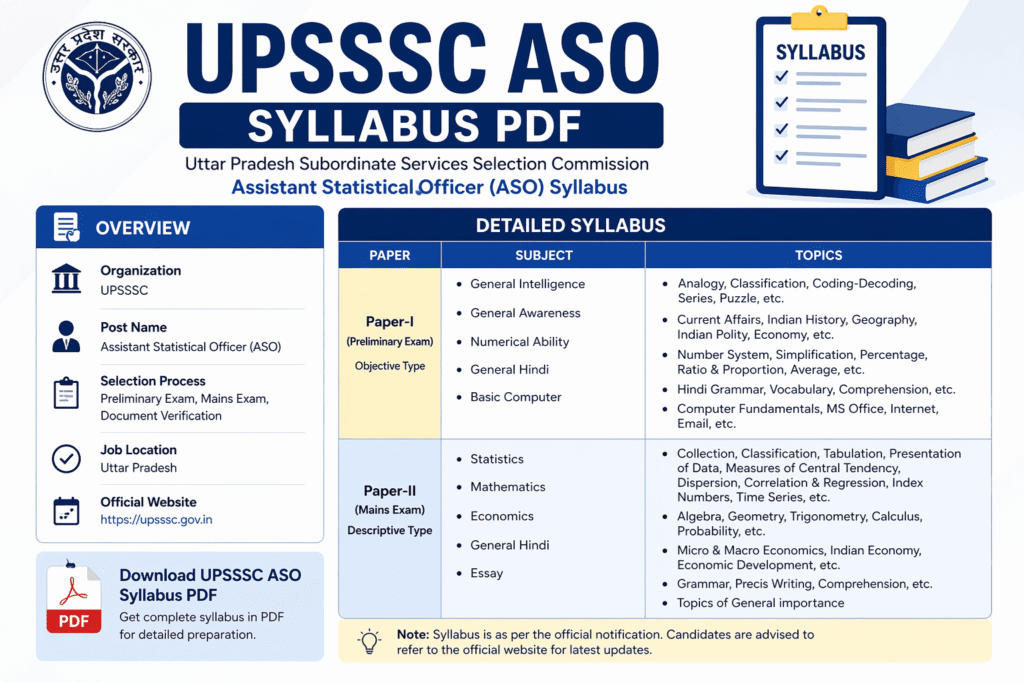
How to Download UPSSSC ASO Syllabus PDF
Follow these steps:
- Visit the official UPSSSC website
- Navigate to the “Notifications” section
- Search for ASO Recruitment 2026
- Click on “Syllabus PDF”
- Download and save it
UPSSSC ASO Syllabus and Exam Pattern Overview 2026
The quick overview of the syllabus and exam pattern is given in the table below:
| UPSSSC ASO Syllabus and Exam Pattern 2026 | |
| Name of Exam Body | Uttar Pradesh Subordinate Services Selection Commission |
| Category | Syllabus and Exam Pattern |
| Name of the Posts | Assistant Statistical Officer and Assistant Research Officer |
| Number of Vacancies | 929 |
| Exam Type | Objective (Multiple Choice Questions) |
| Total Questions | 100 |
| Total Marks | 100 |
| Negative Marking | 0.25 |
| UPSSSC ASO Selection Process | UP PET Score-based Shortlisting, Written Test, and Document Verification |
| Official Website | UPSSSC |
UPSSSC ASO Syllabus 2026
The UPSSSC Statistical Officer Syllabus is divided into three parts: Part 1 consists of Subject-related Knowledge topics, Part-2 consists of Computer & Information Technology topics, and Part 3 consists of questions on UP General Information. The subject-wise topics are listed below:
UPSSSC ASO Syllabus for Subject-related Knowledge (Statistics & Mathematics)
This section is the most important part of the exam, carrying the highest weightage. The section will cover statistical knowledge, data analysis, and mathematical aptitude.
| Subject | Topics & Details |
| Part-1 (Subject-related Knowledge) | Statistics |
| Definition | |
| Scope | |
| Functions | |
| Limitations | |
| Distrust & Misuse | |
| Collection and Presentation of Data | |
| Primary Data | |
| Secondary Data | |
| Elementary idea of Sampling Techniques | |
| Classification | |
| Tabulation & Frequency Distribution | |
| Generation of One-way & Two-way Tables | |
| Measures of Central Tendency and Dispersion | |
| Arithmetic Mean | |
| Geometric Mean | |
| Harmonic Mean | |
| Median & Mode | |
| Range | |
| Quartile Deviation | |
| Mean Deviation | |
| Standard Deviation and Coefficient of Variation | |
| Measures of Skewness & Kurtosis | |
| Index Numbers, Rates & Ratios | |
| Meaning | |
| Importance | |
| Construction and their Calculation | |
| Change of Base | |
| Splicing | |
| Deflating | |
| Understanding of Radix | |
| Rate and Ratios | |
| Correlation and Regression | |
| Linear & Rank Correlation | |
| Simple Regression Analysis | |
| Fundamentals of Mathematics | |
| Elementary Set Theory | |
| Number System | |
| Elementary Algebra | |
| Percentages & Logarithms | |
| Straight lines and Circles | |
| Various types of Growth | |
| Permutations & Combinations, Elementary Probability Theory | |
| Additive and Multiplicative Theorems | |
| Probability and Conditional Probability | |
| Statistical Measures of Indian Economy | |
| Basic Demographic Measures | |
| Labour Statistics | |
| Money & Banking | |
| National Income | |
| Measures of Industrial production | |
| Price Statistics | |
| Basic understanding of NSS Surveys | |
| Indian Statistical System | |
| Structure & Functions of National Statistical Office (NSO) | |
| Department of Economics & Statistics, Government of Uttar Pradesh |
UPSSSC ASO Syllabus for Computer and IT
This section tests basic to intermediate knowledge of computers and modern technological developments.
| Subject | Topics & Details |
| Part-2 (Knowledge of Concepts of Computer and Information Technology) | History and Introduction |
| History of the Computer | |
| Introduction and Application of the Computer | |
| Information Technology | |
| Internet and World Wide Web (WWW) | |
| General Knowledge of IT and Hardware | |
| Hardware and Software | |
| Input and Output devices | |
| Internet Protocol/IP Address | |
| IT gadgets and their applications | |
| Creation of e-mail ID and use/operation of e-mail | |
| Operation of Printer, Tablet and Mobile | |
| Important elements of Word Processing (MS-Word) | |
| Excel Processing (MS-Excel) | |
| Operating System | |
| Social Networking | |
| e-Governance | |
| Digital Finance and Cyber Security | |
| Digital Financial Tools and Applications | |
| Future Skills and Cyber Security | |
| Technological Development and Innovation | |
| Artificial Intelligence | |
| Big Data Processing | |
| Deep Learning | |
| Machine Learning | |
| Internet of Things | |
| India’s achievements in this field |
UPSSSC ASO Syllabus for General Studies of UP
This section will test basic to intermediate knowledge of computers and modern technological developments.
| Subject | Topics & Details |
| Part-3 (General information related to the State of Uttar Pradesh) | History, Culture and Heritage |
| History of Uttar Pradesh | |
| Culture and Art | |
| Architecture | |
| Festivals | |
| Folk Music & Dances | |
| Literature and Regional Languages | |
| Heritage, Social Customs and Tourism | |
| Geography and Environment | |
| Geographical Landscape and Environment | |
| Natural Resources | |
| Climate and Soil | |
| Forests and Wildlife | |
| Mines and Minerals | |
| Economy, Agriculture and Administration | |
| Economy of Uttar Pradesh | |
| Agriculture and Industry | |
| Business and Employment | |
| Polity and Administration | |
| Current Affairs | |
| Current Events of Uttar Pradesh | |
| Achievements of Uttar Pradesh State in various fields |
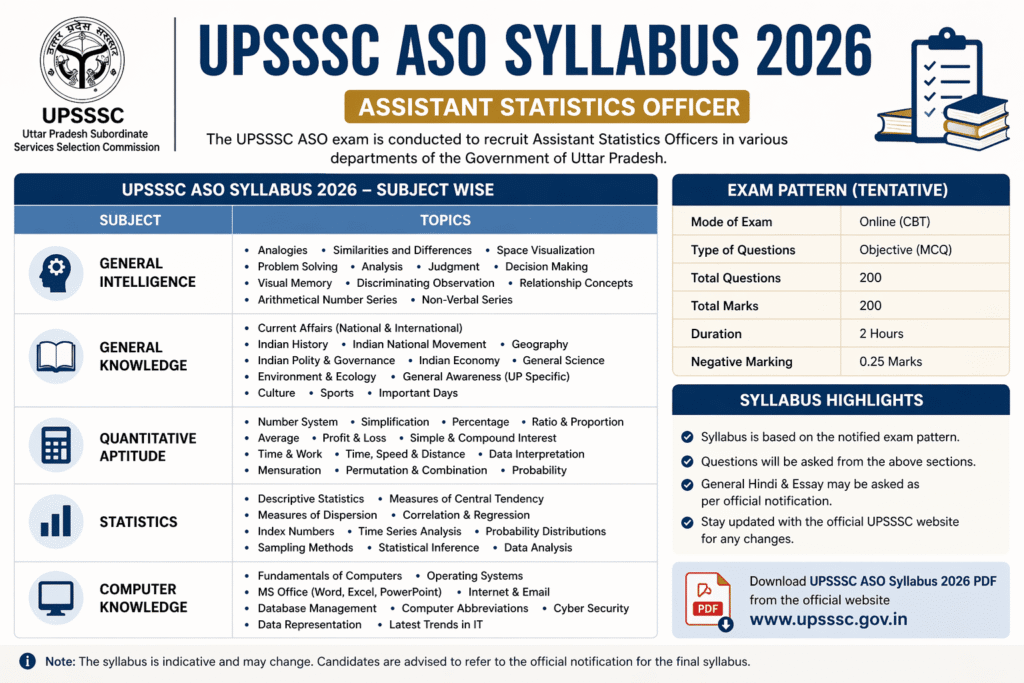
UPSSSC ASO Exam Pattern 2026
The UPSSSC ASO Syllabus 2026 Pattern consists of 100 objective multiple-choice questions of 100 marks. There is a negative marking of 0.25 marks (25%) for each incorrect answer. Candidates will be given 2 hours to complete the Test. The exam structure is detailed below:
| Section | Subjects | Questions | Marks |
| Part-1 | Statistics | 10 | 10 |
| Collection and Presentation of Data | 10 | 10 | |
| Measures of Central Tendency and Dispersion | 10 | 10 | |
| Index Numbers, Rates & Ratios | 05 | 05 | |
| Correlation and Regression | 05 | 05 | |
| Fundamentals of Mathematics | 05 | 05 | |
| Permutations & Combinations, Elementary Probability Theory | 05 | 05 | |
| Statistical Measures of Indian Economy | 10 | 10 | |
| Indian Statistical System | 05 | 05 | |
| Part-2 | Knowledge of concepts of Computer and Information Technology and contemporary technological development and innovation in this field | 15 | 15 |
| Part-3 | General information related to the state of Uttar Pradesh | 20 | 20 |
| Total | 100 | 100 | |
UPSSSC ASO Syllabus 2026 Books
Check books that are recommended by the toppers and experts for the better preparation.
| Subject | Recommended Book | Author/Publisher |
| Statistics | Fundamentals of Mathematical Statistics | S. C. Gupta & V. K. Kapoor |
| Mathematics | Quantitative Aptitude | R. S. Aggarwal |
| Computer & IT | Objective Computer Awareness | Arihant Experts |
| Uttar Pradesh GK | Uttar Pradesh Samanya Gyan | Lucent |
FAQS
Q1.What is the syllabus for ASO?
DSSSB ASO Syllabus 2026
Section
Marks
General Intelligence & Reasoning Ability
40 Marks
General Awareness
40 Marks
Arithmetical & Numerical Ability
40 Marks
English Language & Comprehension
40 Marks
Q2.What is the salary of Upssc ASO?
The in-hand salary for UPSSSC ASOs will fall within the range of approximately Rs. ₹35,400 to ₹1,12,400 per month.
Q3.What is the qualification for ASO in Upsssc?
UPSSSC PET 2025 Score Card. Master Degree in Mathematics, Mathematical Statistics, Commerce, Economics, Statistics from Any Recognized Board in India. O Level Diploma. More Details Read the Notification.
Trending Articles :
RBI Assistant Recruitment 2026
Indian Navy – SSC Officer Entry 2026
SSC GD Constable Exam Slot Selection 2026
CRPF Constable Tradesman Online Form 2026





1 Comment