



UPSSSC Lower PCS Syllabus The Uttar Pradesh Subordinate Services Selection Commission (UPSSSC) has officially released the revised syllabus for the Combined Lower Subordinate Services (Graduate Level) Examination 2026. The updated syllabus is designed to assess candidates across a wide range of subjects, including General Knowledge, Data Interpretation, Hindi Language, Computer Knowledge, and Uttar Pradesh-specific General Awareness.
Thank you for reading this post, don't forget to subscribe!Candidates preparing for the UPSSSC Lower PCS Mains Examination should carefully review the latest syllabus to understand the topics covered and plan their preparation effectively. A thorough understanding of the syllabus will help aspirants create a structured study plan, focus on important areas, and improve their chances of success in the examination.
Read on to explore the detailed UPSSSC Lower PCS Syllabus and Exam Pattern 2026..
For complete details about eligibility, exam pattern, syllabus, vacancy, and application process, candidates can check the detailed article on UPSSSC Lower PCS 2026.
Table of Contents
UPSSSC Lower PCS Syllabus PDF
Candidates can download the UPSSSC Lower PCS Syllabus from the official website or by using the direct PDF link provided below. Keeping a copy of the syllabus readily available can help with effective preparation, quick revisions, and better planning of the study schedule.
UPSSSC Lower PCS Syllabus and Exam Pattern 2026: Overview
The UPSSSC Lower PCS Syllabus provides candidates with a clear understanding of the examination pattern and structure. It outlines important details such as the total number of questions, marking scheme, exam duration, sections covered, and the selection process. Candidates are advised to familiarize themselves with these details before starting their preparation.
| Particulars | Details |
|---|---|
| Exam Name | Combined Lower Subordinate Services (Graduate Level) Main Examination – 2026 |
| Conducting Body | Uttar Pradesh Subordinate Services Selection Commission (UPSSSC) |
| Posts Included | Assistant Treasury Accountant, Auditor, Amin/Auctioneer, Executive Officer, Clerk-cum-Typist, Assistant Excise Officer, Assistant Manager (Non-Technical), Centre In-charge, District Assistant Immunization Officer, Market Supervisor, and other posts |
| Total Vacancies | 2,285 |
| Exam Level | State Level |
| Mode of Examination | Offline (OMR-Based) |
| Total Questions | 100 |
| Maximum Marks | 100 |
| Negative Marking | 0.25 marks deducted for each incorrect answer |
| Exam Duration | 120 Minutes (2 Hours) |
| Sections | Part I, Part II, and Part III |
| Selection Process | Single Objective-Type Written Examination |
| Official Website | UPSSSC Lower PCS Syllabus |
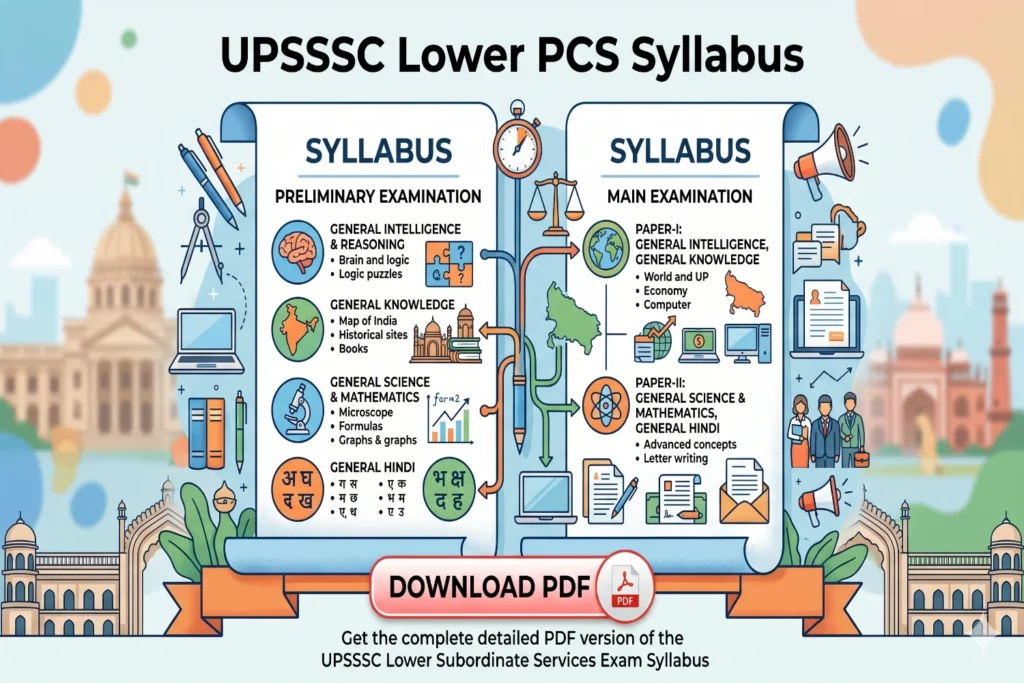
UPSSSC Lower PCS Syllabus
The UPSSSC Lower PCS examination syllabus is divided into three parts:
- Part I – Subject-Related Knowledge
- Part II – Computer and Information Technology
- Part III – General Information Related to Uttar Pradesh
Part I: Subject-Related Knowledge
1. History of India and Indian National Movement
- Social, cultural, economic, and political aspects of Indian history
- Indian freedom struggle and national movement
- Rise of nationalism in India
- Events leading to India’s independence
2. Indian Polity and Constitution
- Constitutional development in India
- Features of the Indian Constitution
- Political system and governance
- Panchayati Raj and local self-government
- Public policy and administration
- Community development programs
- Important government issues and initiatives
3. Geography of India and the World
- Physical, social, and economic geography of India
- Agriculture and horticulture
- Forestry and animal husbandry
- Population growth and urbanization
- Smart cities and smart villages
- Basic knowledge of world geography
4. Indian Economy and Social Development
- Economic planning in India
- Objectives and achievements of planning
- Role and functions of NITI Aayog
- Sustainable Development Goals (SDGs)
- Government budget and financial system
- Development of agriculture, industry, and trade
- Land reforms after independence
- Impact of globalization and liberalization
- Industrial policy reforms and their effects
- Infrastructure development:
- Power
- Roads
- Railways
- Ports
- Airports
5. Current Events of National and International Importance
- Important national current affairs
- Significant international developments and events
6. Science and Technology
- Applications of India’s Science and Technology Policy
- Science and technology for development and national security
- Contributions of Indian scientists
- Technology indigenization
- Emerging technologies and innovations
- Space technology
- Defence technology
- Energy resources
- Nanotechnology
- Microbiology
- Biotechnology
- Intellectual Property Rights (IPR)
- Digital rights and related issues
7. Environmental Ecology and Disaster Management
Environmental Ecology
- Environmental protection
- Ecosystems
- Biodiversity conservation
- Wildlife protection
- Environmental pollution and degradation
- Environmental Impact Assessment (EIA)
- Climate change
Disaster Management
- Disaster mitigation and management in India
- Disaster Management Act, 2005
- National Disaster Management Authority (NDMA)
- State Disaster Management Authority (SDMA)
- National Disaster Response Force (NDRF)
- State Disaster Response Force (SDRF)
- Agencies involved in disaster management
- Global initiatives and achievements in disaster management
8. Data Interpretation
- Data analysis and interpretation
- Statistical analysis
- Graphs, charts, and diagrams
- Drawing conclusions from statistical and graphical information
9. General Hindi
Official Communication
- Official, semi-official, personal, and professional correspondence
- Letters, office orders, notifications, and circulars
Language Fundamentals
- Varna (letters) and sounds
- Pronunciation and writing
- Vowels, consonants, and matras
- Classification of sounds
Word Formation
- Sandhi and Sandhi-Vicched
- Samas (compounds)
- Upasarg (prefixes)
- Pratyay (suffixes)
Vocabulary and Grammar
- Tatsam, Ardha-Tatsam, Tadbhav, Deshaj, and foreign words
- Nouns, pronouns, adjectives, verbs, and indeclinables
- Synonyms and antonyms
- One-word substitutions
- Similar-sounding words
- Word selection and word correction
- Gender, number, person, tense, mood, aspect, and voice
- Case markers (Parsarg)
Sentence Structure
- Simple, compound, and complex sentences
- Sentence correction
- Punctuation marks
Idioms and Proverbs
- Muhavare (idioms)
- Lokoktiyan (proverbs)
Part II: Computer and Information Technology
This section evaluates candidates’ understanding of basic computer concepts and modern technologies.
Computer Fundamentals
- History and introduction of computers
- Information Technology (IT) concepts
- Internet and World Wide Web (WWW)
- Hardware and software
- Input and output devices
- Internet Protocol (IP) and IP addresses
Digital Applications
- IT gadgets and their applications
- Creating and operating e-mail accounts
- Usage of printers, tablets, and mobile devices
- MS Word and MS Excel fundamentals
- Operating systems
- Social networking platforms
- E-Governance initiatives
- Digital financial tools and applications
Emerging Technologies
- Cyber Security
- Future Skills
- Artificial Intelligence (AI)
- Big Data Processing
- Machine Learning (ML)
- Deep Learning
- Internet of Things (IoT)
- Recent technological developments
- India’s achievements in Information Technology
Part III: General Information Related to Uttar Pradesh
History and Culture
- History of Uttar Pradesh
- Art and cultural heritage
- Architecture of Uttar Pradesh
- Festivals and folk dances
- Literature and regional languages
- Social customs and traditions
Tourism and Heritage
- Major tourist destinations
- Historical and cultural heritage sites
Geography and Environment
- Physical geography of Uttar Pradesh
- Climate and environment
- Natural resources
- Soil types
- Forests and wildlife
- Mines and minerals
Economy and Agriculture
- Agriculture and allied sectors
- Industrial development
- Business and employment opportunities
Polity and Administration
- Political and administrative structure of Uttar Pradesh
- Governance and public administration
Current Affairs of Uttar Pradesh
- Recent developments and important events
- Achievements of Uttar Pradesh in various sectors
Note: The revised syllabus has removed General Intelligence and Elementary Mathematics, while Data Interpretation has been newly added. Additionally, General Science has been replaced by Science and Technology.
UPSSSC Lower PCS Exam Pattern
The exam is conducted in two stages: a preliminary examination (objective type) and a main examination (descriptive type). Here’s a breakdown of the expected pattern for 2026:
Preliminary Examination
– Type: Objective (Multiple Choice Questions)
– Duration: 2 hours
– Total Marks: 200
– Sections:
– General Studies (100 marks)
– General Hindi (50 marks)
– General Intelligence & Reasoning (50 marks)
– Negative Marking: 0.25 marks deducted for each wrong answer
Main Examination
– Type: Descriptive (Written)
– Duration & Marks: Varies by paper
– Papers Included:
– General Hindi (Essay, Comprehension, Grammar)
– General Studies (Essay & Objective Questions)
– Optional Subject (Chosen by the candidate)
Key Topics in the UPSSSC Lower PCS Syllabus
To excel in the exam, candidates must focus on the following key areas:
1. General Studies
This section tests a candidate’s awareness of current affairs, history, geography, and more. Important topics include:
– Indian History & Culture: Ancient, medieval, and modern history, freedom struggle, art, and heritage.
– Indian Polity & Governance: Constitution, political system, Panchayati Raj, and public policy.
– Geography: Physical, economic, and social geography of India and Uttar Pradesh.
– Economy: Basic economic concepts, budgeting, agriculture, and industrial development.
– Science & Technology: Recent advancements, space technology, and environmental issues.
– Current Affairs: National and international events, government schemes, and sports.
2. General Hindi
This section evaluates proficiency in Hindi, covering:
– Grammar: Sandhi, samas, idioms, and sentence correction.
– Comprehension: Passages followed by questions.
– Essay Writing: Topics related to social issues, governance, or general awareness.
3. General Intelligence & Reasoning
This section assesses logical and analytical skills through:
– Verbal Reasoning: Analogies, coding-decoding, and series completion.
– Non-Verbal Reasoning: Pattern recognition, visual puzzles, and spatial ability.
– Quantitative Aptitude: Basic arithmetic, algebra, and data interpretation.
Preparation Tips for UPSSSC Lower PCS 2026
– Understand the Syllabus Thoroughly: Focus on high-weightage topics and prioritize weak areas.
– Practice Previous Years’ Papers: Helps in understanding question patterns and time management.
– Stay Updated with Current Affairs: Regularly read newspapers and follow reliable news sources.
– Revise Regularly: Consistent revision ensures retention of key concepts.
– Take Mock Tests: Simulates exam conditions and improves speed and accuracy.
Candidates preparing for the examination can find complete information regarding vacancies, eligibility criteria, syllabus, and selection process in the detailed article: UPSSSC Lower PCS 2026 Notification Details.
UPSSSC Lower PCS Syllabus Conclusion
The UPSSSC Lower PCS Syllabus demands a well-structured preparation strategy covering all subjects systematically. By understanding the exam pattern, focusing on key topics, and practicing diligently, candidates can enhance their chances of clearing the exam. Staying disciplined and motivated throughout the preparation journey is the key to success.
UPSSSC Lower PCS Syllabus FAQ:
Q1.What are the major changes in the UPSSSC Lower PCS Syllabus?
General Intelligence (Reasoning) and Elementary Mathematics have been completely removed.
Data Interpretation (DI) has been added.
Science & Technology has replaced the traditional General Science section.
Q2.How many questions will be there in the main exam?
The written exam will contain exactly 100 Multiple Choice Questions (MCQs).
Q3.What is the total marks and duration of the exam?
The exam is worth 100 marks to be completed in 2 hours (120 minutes).
Q4.Is there any negative marking in the UPSSSC Lower PCS exam?
Yes, a penalty of 1/4th (0.25) mark is deducted for every incorrect answer
Trending Articles :
- Railway ALP Recruitment 2026
- CRPF Constable Tradesman Recruitment 2026
- TCS Recruitment 2026
- UPSSSC ASO 2026 Online Form
- TSPSC Job Notification 2026
- TS Intermediate Results 2026
- SSC GD Constable Exam Slot Selection 2026
- CRPF Constable Tradesman Online Form 2026
- BPSC 72nd Pre Online Form 2026
- LIC HFL Jr Assistant 2026 Apply Online
- UPSSSC ASO 2026
- Assistant Loco Pilot 2026
- SBI Trade Finance Officer Recruitment 2026
- Railway RRB Technician Online Form 2026




2 Comments