




UPPSC PCS Exam 2026 isn’t just another government exam — it’s the exam that decides whether you’ll sit across the table as a Deputy Collector or Deputy SP, or keep preparing for one more attempt. Every year, lakhs of graduates from Lucknow to Gorakhpur to Meerut apply for a few hundred seats, making this one of the most fiercely contested state-level recruitment exams in India.
Thank you for reading this post, don't forget to subscribe!This guide walks through everything currently known about the UPPSC PCS Exam 2026 cycle — the Mains exam schedule, the 200 vacancies notified, eligibility rules, exam pattern, syllabus structure, expected cutoffs, and a realistic month-by-month preparation roadmap. Rather than repeating dry notification text, we’ve tried to explain why certain stages matter, what commonly trips up first-time candidates, and how toppers actually structure their last six months. Wherever something is provisional (like the 2026 notification, which is still awaited), we’ve flagged it clearly so you don’t confuse expected dates with confirmed ones.
Table of Contents
What Exactly Is the UPPSC PCS Exam?
The Uttar Pradesh Public Service Commission (UPPSC) conducts the Combined State/Upper Subordinate Services Examination — popularly shortened to PCS — to recruit officers for administrative and subordinate posts across the state government. Successful candidates go on to become Deputy Collectors, Deputy Superintendents of Police, Block Development Officers, District Commandants, Treasury Officers, and more.
Unlike the UPSC Civil Services Exam, which recruits for all-India services like IAS and IPS, UPPSC PCS is a state cadre exam — successful candidates serve within Uttar Pradesh. That said, the exam’s difficulty, competition, and prestige are comparable to many national-level exams, largely because UP is India’s most populous state and produces one of the largest pools of civil service aspirants every year.
The recruitment happens through three clearly defined stages, and each stage filters out a large chunk of the applicant pool before the final merit list is prepared.
UPPSC PCS 2025–26 Cycle: Where Things Stand
Here’s a snapshot of the current cycle so you know exactly which stage is active and what to expect next.
| Stage | Status | Date/Details |
|---|---|---|
| Prelims Exam | Conducted | 12th October 2025 |
| Mains Exam | Scheduled | 29th March – 1st April 2026 |
| Admit Card (Mains) | Released | Available on the official UPPSC portal |
| Notified Vacancies | Announced | 200 posts |
| 2026 Fresh Notification | Awaited | Expected around January–February 2026 |
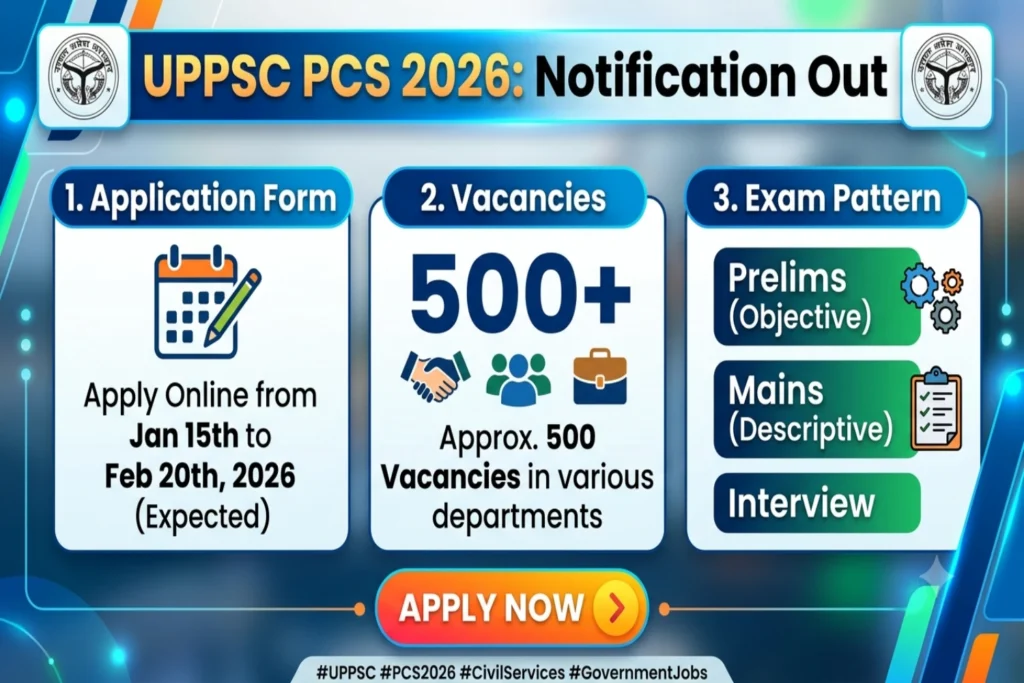
A quick but important clarification: candidates often confuse the “2025 cycle” with the “2026 cycle.” The exam that concluded Prelims in October 2025 and is holding Mains in March–April 2026 is technically the UPPSC PCS 2025 recruitment cycle — it’s just that the Mains happens to fall in calendar year 2026. A separate, fresh notification for the 2026 recruitment cycle is expected to be released independently, likely in the first quarter of 2026, following the usual pattern where UPPSC opens applications a few months after the previous cycle’s prelims.
UPPSC PCS Mains 2026 Exam Schedule
The Mains examination is a four-day affair with two sessions daily — a structure that tests not just knowledge but also stamina and time management.
| Date & Day | Forenoon Session (9:00 AM – 12:00 PM) | Afternoon Session (2:30 PM – 5:30 PM) |
|---|---|---|
| 29 March 2026 (Sunday) | General Hindi | Essay |
| 30 March 2026 (Monday) | General Studies – I | General Studies – II |
| 31 March 2026 (Tuesday) | General Studies – III | General Studies – IV |
| 1 April 2026 (Wednesday) | General Studies – V (UP Special) | General Studies – VI (UP Special) |
Notice how the first day eases candidates in with language and essay papers, before the General Studies papers — which carry the heaviest weight in the merit calculation — take over for the remaining three days. Papers V and VI deserve special mention: these are UP-specific General Studies papers, meaning generic national-level GS preparation alone won’t cut it. You’ll need dedicated notes on UP’s history, geography, economy, and governance structure.
UPPSC PCS Exam Overview 2026
| Particular | Details |
|---|---|
| Exam Name | Uttar Pradesh Combined State/Upper Subordinate Services Exam |
| Conducted By | Uttar Pradesh Public Service Commission (UPPSC) |
| Exam Level | State |
| Frequency | Annual |
| Mode | Offline (Pen and Paper) |
| Stages | Prelims → Mains → Interview |
| Prelims Duration | 2 hours per paper |
| Mains Duration | 3 hours per paper |
| Vacancies (2025 cycle) | 200 |
| Salary Range | ₹9,300 – ₹39,100 (pre-revised scale, plus grade pay) |
| Official Website | uppsc.up.nic.in |
uppsc pcs eligibility criteria 2026
Before you plan a six-month study calendar, make sure you actually qualify. The two gates are age and education.
Age Limit: Candidates must be between 21 and 40 years as on the cutoff date specified in the notification. Reserved category candidates (OBC, SC, ST, and other applicable groups) get standard age relaxations as per UP government norms — typically 5 years, though it’s worth checking the exact relaxation table in each year’s notification since it can shift.
Educational Qualification: A Bachelor’s degree from a UGC-recognised university is the baseline requirement for most posts. A handful of specific posts (like certain technical or legal positions within the PCS umbrella) may ask for specific degrees — always cross-check the post-wise eligibility annexure in the official notification rather than relying on a generic checklist.
One practical tip: many aspirants apply while still awaiting their final-year results. UPPSC generally allows this, but you must have the degree in hand by the time of document verification. Don’t gamble on this without reading the specific year’s notification clause on it.
uppsc pcs exam pattern 2026
Stage 1: Preliminary Examination
The Prelims is objective-type and purely qualifying — meaning your Prelims score does not carry forward into the final merit list. It only decides whether you advance to Mains.
| Paper | Type | Marks | Nature |
|---|---|---|---|
| General Studies Paper I | Objective | 200 | Counts toward Prelims cutoff |
| General Studies Paper II (CSAT) | Objective | 200 | Qualifying (minimum 33%) |
A trap many first-attempt candidates fall into: treating CSAT casually because “it’s just qualifying.” It is qualifying, but the 33% threshold has caught out otherwise strong candidates who assumed basic aptitude would carry them through without practice. Don’t skip CSAT mocks entirely.
Stage 2: Main Examination
This is where the real merit-building happens. Seven compulsory descriptive papers, totaling 1,500 marks.
| Paper | Subject | Marks |
|---|---|---|
| Paper 1 | General Hindi | 150 |
| Paper 2 | Essay | 150 |
| Paper 3 | General Studies I | 200 |
| Paper 4 | General Studies II | 200 |
| Paper 5 | General Studies III | 200 |
| Paper 6 | General Studies IV | 200 |
| Paper 7 | General Studies V (UP-specific) | 200 |
| Paper 8 | General Studies VI (UP-specific) | 200 |
(Note: UPPSC’s paper-numbering across GS I–VI totals six GS papers plus Hindi and Essay — seven compulsory heads in total, summing to 1,500 marks.)
Stage 3: Interview / Personality Test
Worth 100 marks and added directly to your Mains score for the final merit list. Unlike the Prelims, this stage is not merely a formality — a difference of even 10-15 marks here has historically shifted final rankings meaningfully, especially for candidates clustered near cutoff.
Total marks that decide your final rank: 1,500 (Mains) + 100 (Interview) = 1,600 marks.
uppsc pcs syllabus 2026
Rather than listing every sub-topic (the official syllabus PDF does that), here’s how to think about the syllabus strategically.
Prelims GS Paper I covers History, Geography, Indian Polity, Economy, Environment & Ecology, General Science, and Current Affairs — with a visible UP-centric tilt in several questions each year.
Prelims CSAT tests comprehension, logical reasoning, basic numeracy, and decision-making — closer to an aptitude test than a knowledge test.
Mains General Studies papers are broader and deeper than Prelims, expecting analytical, essay-style answers rather than one-line facts. GS-V and GS-VI, being UP-specific, ask detailed questions on the state’s history, culture, geography, economy, administrative structure, and current government schemes — an area candidates from outside UP, or those relying purely on national-level books, often underprepare for.
uppsc pcs vacancy 2026
The 2025 cycle notification announced 200 vacancies spread across various administrative and subordinate posts, including:
- Deputy Collector / District Administrative Officer
- Assistant Conservator of Forest
- Range Forest Officer
- District Audit Officer
- Assistant Labour Commissioner
- Sub Registrar
- Food Safety Officer
- Assistant Research Officer
Vacancy numbers for the fresh 2026 notification will be published once UPPSC releases it — historically, this figure fluctuates year to year based on staffing needs across departments, so don’t assume it’ll match 2025’s number.
UPPSC PCS Salary
| Post Category | Pay Scale (approx.) | Grade Pay |
|---|---|---|
| Junior-level posts | ₹9,300 – ₹34,800 | ₹4,200 – ₹4,600 |
| Senior-level posts (e.g., Deputy Collector, DSP) | ₹15,600 – ₹39,100 | ₹5,400 |
These figures follow the pre-7th Pay Commission structure that UPPSC notifications still typically reference; actual take-home pay, once revised scales and allowances (DA, HRA, TA) are applied, is meaningfully higher than the base figures suggest.
Expected UPPSC PCS Cut Off Trends
Cutoffs shift depending on the number of vacancies, the paper’s difficulty level, and how many candidates appear. A few patterns worth knowing:
- General category cutoffs are consistently the highest across both Prelims and Mains.
- Reserved category cutoffs (SC/ST/OBC) run lower due to statutory relaxations, but the gap has been narrowing in recent cycles as competition intensifies across categories.
- A tougher Prelims paper typically pushes cutoffs down; an easier paper pushes them up — so don’t panic if a paper “felt hard.” Difficulty is relative across the whole candidate pool.
Since cutoffs are released officially only after each stage, treat any pre-result cutoff figure you see online as an estimate, not a guarantee.
UPPSC PCS Apply Online 2026: Step-by-Step Process
Applications for UPPSC PCS are accepted exclusively online — there’s no offline or postal submission route, so candidates must apply through the official UPPSC portal at uppsc.up.nic.in. The process itself isn’t complicated, but it does involve a few sequential steps, and skipping or rushing any one of them is a common reason candidates end up with rejected or incomplete applications.
Here’s how the full process breaks down:
Step 1: Complete Your One Time Registration (OTR)
Before you can even see the PCS application form, you need an active OTR profile. This is done on the UPPSC OTR portal, where you’ll enter your personal details, academic qualifications, and contact information to generate a permanent registration ID and password.
The good news: this isn’t a one-exam-only registration. Once your UPPSC OTR is created, it stays valid for every future exam the commission conducts — so if you’ve registered for any previous UPPSC recruitment, you can skip straight to Step 2 using your existing credentials.
Step 2: Log In and Fill the Application Form
Using your OTR ID and password, log in to the UPPCS Application Form portal and start filling in the exam-specific sections — your name, current address, educational qualifications, and post preferences (where applicable). Double-check every entry here; unlike the OTR, this section is exam-specific and errors can be harder to fix once submitted.
Step 3: Upload Your Photograph and Signature
Next, upload a recent scanned photograph and signature, following the exact dimension and file-size specifications given in that year’s official notification. UPPSC is fairly strict about this — an image even slightly outside the prescribed size can get flagged during scrutiny. If your files don’t match the requirements, tools like Naukriduniya Photo Cropping Tool can help you resize and format them correctly before upload.
Step 4: Pay the Application Fee and Submit
Go through your entire application once more before hitting submit — this is your last real chance to catch mistakes. Once you’re confident everything is accurate, proceed to pay the applicable fee online (fee amounts vary by category, so confirm the correct figure for yours in the notification) and finalize your submission.
Step 5: Save and Print a Copy for Your Records
Once submitted, download and print a hard copy of your completed application. Keep it safe — you’ll likely need it at later stages such as document verification or the interview, and having a physical reference also helps if you ever need to cross-check what you originally submitted.
How to Prepare: A Realistic Study Approach
Start with NCERTs, not advanced books. Class 6–12 NCERTs for History, Geography, Polity, and Economy build the base that advanced books like Laxmikant (Polity) or Ramesh Singh (Economy) then build on. Skipping this step and jumping straight to advanced texts is one of the most common reasons candidates feel “I’ve read so much but retain so little.”
Don’t neglect UP-specific content. Since GS-V and GS-VI in Mains are entirely UP-focused, and Prelims also weaves in UP-specific questions, build a separate UP notes file covering UP’s Five-Year Plans, major rivers and irrigation projects, tribal population distribution, and current state government schemes.
Practice answer writing early, not two months before Mains. Mains is descriptive; the skill of structuring a 150-200 word answer under time pressure needs months of practice, not weeks.
Use previous year papers as a diagnostic tool, not just a revision tool. Attempting a paper from 3-4 years ago early in your preparation tells you exactly which sections need more work, before you’ve spent months on the wrong emphasis.
Take sectional mock tests for CSAT even if you’re traditionally strong at comprehension and reasoning — timed pressure changes how these questions feel.
UPPSC PCS Application Fees 2026
To complete the UPPCS application process one must pay the required application fee on or before the deadline for online applications. The UPPSC PCS Application Fee for various categories is as follows –
| UPPCS Application Fee | |
| Category | Fee |
| General/OBC/EWS | Rs. 125 |
| SC/ST | Rs. 65 |
| PWD | Rs. 25 |
| Ex-Servicemen | Rs. 65 |
| Dependents of the Freedom Fighters | As per their original category |
| Women/Skilled/Outstanding Sports Person | As per their original category |
Common Mistakes Aspirants Make (And How to Avoid Them)
- Ignoring current affairs until the last two months — build a monthly current affairs digest habit from day one instead of cramming a year’s news at the end.
- Treating the interview as an afterthought — mock interviews and daily newspaper reading for opinion-building matter as much as GS revision in the final weeks.
- Over-relying on coaching notes without reading primary sources — notes are useful for revision, not for building first-principles understanding.
- Not tracking application deadlines closely — a missed OTR update or a late fee payment can knock you out before the exam even begins.
UPPSC PCS Exam 2026 FAQs
Q1. What is the UPPSC PCS Exam?
It’s the Uttar Pradesh Combined State/Upper Subordinate Services Exam, conducted annually by UPPSC to recruit officers for various administrative and subordinate posts within Uttar Pradesh.
Q2. What is the UPPSC PCS Exam Date for Mains 2026?
The Mains exam is scheduled from 29th March to 1st April 2026, across four days with two sessions each day.
Q3. How many vacancies were announced for UPPSC PCS 2025–26?
200 vacancies were notified across various administrative and subordinate posts
Q4. What is the selection process for UPPSC PCS?
Candidates go through three stages: the Preliminary Examination (objective, qualifying), the Main Examination (descriptive, merit-counting), and the Interview/Personality Test (also merit-counting).
Q5. What is the age limit for the UPPSC PCS Exam?
Candidates must be between 21 and 40 years old, with standard age relaxation for reserved categories.
Q6. Is the UPPSC PCS 2026 fresh notification out yet?
Not as of the latest update — it’s expected around January–February 2026, following the typical release pattern seen in previous cycles.
Q7. What’s the difference between UPSC and UPPSC?
UPSC recruits for all-India services like IAS, IPS, and IFS across the country. UPPSC recruits specifically for Uttar Pradesh state administrative and subordinate services — the roles, cadre, and posting jurisdiction are different.
Q8. How is the final UPPSC PCS merit list prepared?
The final merit list combines the Mains score (1,500 marks) and Interview score (100 marks) — Prelims marks are not counted, only used to qualify for Mains
Trending Articles :
- TCS Recruitment 2026
- TSPSC Job Notification 2026
- LIC HFL Jr Assistant 2026 Apply Online
- UPSSSC ASO 2026
- Assistant Loco Pilot 2026
- SBI Trade Finance Officer Recruitment 2026
- Railway RRB Technician Online Form 2026
- TNPSC Application Correction 2026
- UPSSSC Excise Constable Eligibility 2026
- TGPSC Govt Jobs 2026
- Coal India CIL Management Trainee Syllabus 2026
- TSPSC Group 1 Syllabus 2026
- APTRANSCO AEE Recruitment 2026
- RRB Technician Recruitment 2026
- IOCL Apprentice Recruitment 2026
- Peddapalli Anganwadi Teacher Recruitment 2026
- TCS NQT 2026





Leave a comment