

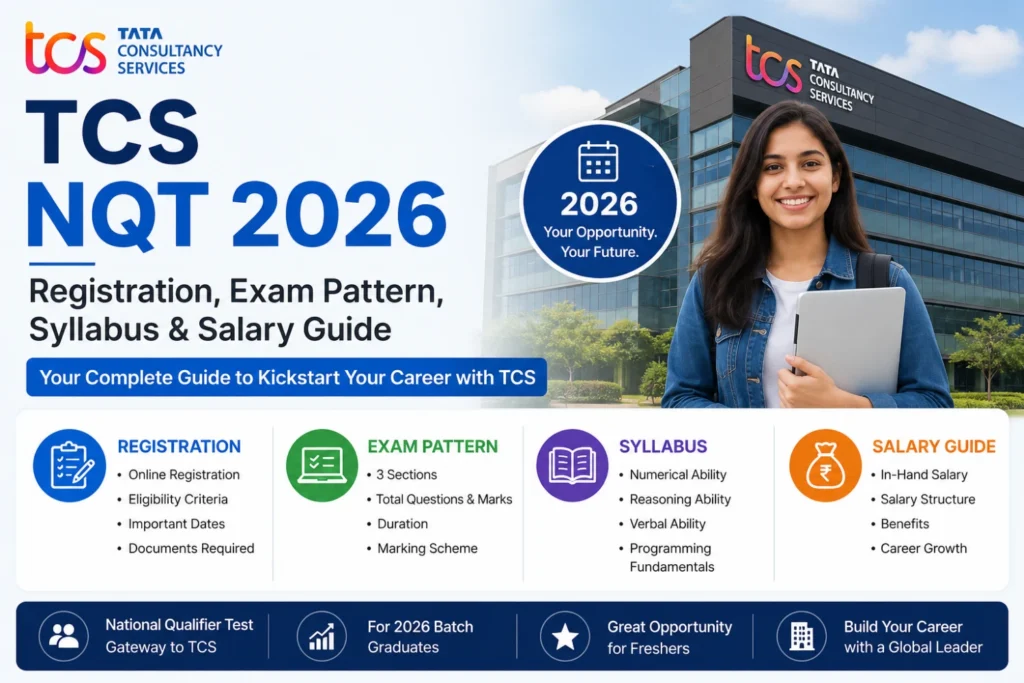
TCS NQT 2026 — the Tata Consultancy Services National Qualifier Test — has become the single biggest entry point for freshers trying to break into India’s IT industry, and for good reason. One test, taken once, can open interview doors not just at TCS but at more than 4,000 partner companies ranging from Titan and Asian Paints to Mphasis and TVS Motor.
Thank you for reading this post, don't forget to subscribe!I’ve worked with several final-year students over the past two hiring cycles who treated NQT as “just another aptitude test” and paid for it later — either by under-preparing for the coding section or by missing the registration window entirely because they assumed the exam only happens once a year. It doesn’t. TCS iON runs fresh cycles roughly every 2 to 4 weeks, which is both an opportunity (you get more shots) and a trap (it’s easy to procrastinate when you think there’s “always a next one”).
This guide pulls together everything you actually need — eligibility rules, the real exam pattern with section-wise timing, the syllabus broken down by weightage, salary bands for Ninja, Digital and Prime, and a preparation roadmap that doesn’t waste your time on topics TCS barely tests. Wherever official numbers change between cycles (and they do), I’ve flagged it so you know to double-check on the TCS iON portal before you finalize your prep plan.
for complete guide about tcs tcs recruitment you can visit TCS Recruitment 2026
Table of Contents
What Exactly Is TCS NQT 2026?
The TCS National Qualifier Test is a standardised, computer-based assessment run on the TCS iON platform. It evaluates cognitive ability, verbal and reasoning skills, and — for candidates chasing IT roles — programming logic and coding proficiency. There are actually two distinct routes under the NQT umbrella, and mixing them up is one of the most common mistakes candidates make:
- TCS All India NQT (Free Direct-Hiring Drive): This is TCS’s own campus-style hiring test, open to the graduating batches of 2024, 2025 and 2026 with a technical degree background. Clearing it can lead directly to a Ninja, Digital or Prime offer at TCS.
- TCS iON NQT (Paid Scorecard Exam): This variant is open to a much wider audience — any stream, any degree, batches from 2022 to 2028 — and produces a scorecard that’s accepted by thousands of other recruiters, not just TCS. It typically costs somewhere in the ₹500–₹800 range depending on the variant chosen.
Understanding which one you’re registering for matters because the eligibility criteria, fee structure, and hiring outcome are genuinely different.
TCS NQT 2026: Key Dates and Cycle Overview
TCS NQT doesn’t run on a single national date the way some entrance exams do. Instead, it operates in recurring windows throughout the year. Here’s a representative snapshot of how a cycle typically unfolds — use this as a template for planning, but always confirm the live dates on the official portal since they shift with every cycle.
| Event | Typical Timeline |
|---|---|
| Registration opens | Announced on TCS NextStep / TCS iON portal |
| Registration closes | Usually 10–20 days after opening |
| Admit card release | 3–5 days before the exam |
| Exam date | Every 2–4 weeks (rolling cycles) |
| Result/scorecard release | 2–4 weeks after the test |
| Interview shortlisting | Rolling, based on section-wise cut-offs |
Because both the free All India drive and the paid iON variant run on overlapping but separate calendars, it’s worth bookmarking the official notification page rather than relying on a screenshot from a WhatsApp forward. A number of fraudulent “TCS hiring” messages circulate every cycle — TCS has repeatedly clarified it never asks for payment for a job offer and never emails from personal Gmail or Yahoo addresses.
TCS NQT 2026 Eligibility Criteria
Eligibility depends on which track you’re applying for. Here’s the breakdown.
Eligibility for TCS All India NQT (Direct Hiring)
| Criterion | Requirement |
|---|---|
| Qualification | B.Tech/B.E., M.Tech/M.E., MCA, M.Sc./M.S. in any specialization from an AICTE/UGC-recognized institution |
| Batch | 2024, 2025, or 2026 graduating batch |
| Academic aggregate | Minimum 60% (or equivalent CGPA) in Class 10, Class 12, Diploma (if applicable), Graduation and Post-Graduation |
| Backlogs | No active backlog at the time of the interview/offer stage |
| Gap years | Reasonable, consistent academic gaps generally accepted; extended or unexplained gaps may be scrutinized |
Eligibility for TCS iON NQT (Scorecard Exam)
| Criterion | Requirement |
|---|---|
| Qualification | Any stream, any degree — UG, PG or Diploma |
| Batch | Passing out between 2022 and 2028, including pre-final and final year students |
| Work experience | Freshers and working professionals with up to 2 years of experience can apply |
| Fee | Paid (varies by variant chosen, typically ₹500–₹800 inclusive of taxes) |
The iON variant’s eligibility is intentionally broad — TCS built it this way so that commerce, arts, and management graduates could also access its 4,000+ partner-company job network, not just engineering students. If you’re a B.Com or BA graduate wondering whether TCS NQT 2026 applies to you, the answer is yes — just make sure you’re registering under the correct category during signup.
TCS NQT 2026 Exam Pattern: Section-Wise Breakdown
This is where most candidates lose marks — not because the questions are unusually hard, but because they misjudge the timing. The TCS NQT 2026 exam pattern is split into a Foundation section (compulsory for everyone) and an Advanced section (compulsory only if you’re targeting Digital or Prime offers).
| Section | Duration | Focus Area |
|---|---|---|
| Numerical Ability | 25 minutes | Arithmetic, algebra, geometry, data interpretation, basic statistics |
| Verbal Ability | 25 minutes | Grammar, vocabulary, reading comprehension, sentence correction |
| Reasoning Ability | 25 minutes | Logical puzzles, series, analogies, pattern recognition |
| Advanced Quantitative & Reasoning | 25 minutes | Complex quant problems, data sufficiency, advanced logic |
| Advanced Coding | 90 minutes | Programming in C, C++, Java, Python or Perl; data structures & algorithms |
Total duration: approximately 190 minutes, though this can vary slightly by variant. A few practical points worth internalizing:
- There is no negative marking, so an educated guess is always better than leaving a question blank.
- The Foundation section alone decides your eligibility for a Ninja offer. If Digital or Prime is your target, the Advanced section is non-negotiable — skipping it caps your outcome at Ninja regardless of how well you scored on Foundation.
- The exam is conducted only in English, so there’s no regional-language option to fall back on.
- Candidates get access to practice tests before the real exam — typically two for Cognitive skills and two for IT Programming, each attemptable up to five times. Use these; they mirror the real interface closely enough that skipping them is genuinely a wasted advantage.
Foundation vs Advanced — Which Should You Prioritize?
If your goal is simply to get any offer and start earning, focus your energy on nailing the Foundation section cleanly. If you’re aiming for a Digital or Prime role with meaningfully better pay and project exposure, budget your prep time roughly 40% Foundation / 60% Advanced, because the coding section alone eats up nearly half the total exam duration.
TCS NQT 2026 Syllabus: Topic-Wise Weightage
Based on patterns observed across recent NQT cycles, here’s how topics tend to be distributed. Treat this as a study-priority guide, not a guarantee of exact question counts.
| Section | High-Frequency Topics |
|---|---|
| Numerical Ability | Percentages, profit & loss, time-speed-distance, permutations & combinations, data interpretation charts |
| Verbal Ability | Reading comprehension, error spotting, para jumbles, synonyms/antonyms |
| Reasoning Ability | Coding-decoding, blood relations, seating arrangement, syllogisms, number/letter series |
| Advanced Quant | Data sufficiency, probability, mixed quant word problems |
| Coding | Arrays, strings, loops, recursion, basic OOP concepts, time complexity of simple algorithms |
A good rule of thumb from watching multiple cohorts prepare: candidates who consistently clear the cut-off treat coding practice as a daily habit, not a weekend cram session. Even 45 minutes a day on basic data structures over three weeks outperforms a single all-nighter before the exam.
TCS NQT 2026 Salary: Ninja, Digital and Prime Compared
Your exam performance directly determines which offer tier you land in. Here’s how the three TCS cadres typically compare.
| Cadre | Indicative CTC (UG) | Indicative CTC (PG) | Role Focus |
|---|---|---|---|
| Ninja | ₹3.4 LPA and above | ₹3.6 LPA and above | Entry-level IT support, maintenance, and development roles |
| Digital | Higher than Ninja, varies by drive | Higher than Ninja, varies by drive | Emerging tech — cloud, AI/ML, full-stack development |
| Prime | Premium band, typically the highest among the three | Premium band | Product engineering and specialized digital roles |
Beyond TCS itself, candidates using their iON NQT scorecard to apply through the wider partner network have reported packages going up to roughly ₹19 LPA, though this depends entirely on the hiring company and role — TCS does not guarantee this figure, and it should be read as an upper-range data point rather than an average.
How to Register for TCS NQT 2026 — Step by Step
- Visit the TCS NextStep portal (for the free All India drive) or the TCS iON NQT page (for the paid scorecard exam).
- Create a new account if you’re a first-time user, or log in with your existing TCS Reference ID (CT/DT number) if you’ve registered before.
- Select the correct category — “IT” for the All India drive, or the relevant stream for the iON variant.
- Fill in your academic and personal details carefully. Errors in your Year of Passing or Highest Qualification are one of the top reasons the “Apply for Drive” button doesn’t appear for eligible candidates.
- Choose your preferred test mode — in-centre or online — and, where applicable, select up to three preferred test centres.
- Click “Apply for Drive.” This step is mandatory; simply completing registration without clicking apply means you will not be considered.
- Track your status under “Track Your Application” — it should read “Applied for Drive” once successful.
- Download your admit card once released and confirm your shift timing (morning or afternoon slots are common).
Preparation Strategy: A Practical 4-Week Roadmap
Week 1 — Foundation Building: Revise core quant formulas, verbal grammar rules, and basic reasoning patterns. Take one diagnostic mock to identify weak areas.
Week 2 — Targeted Practice: Focus daily practice on your two weakest sections. Start light coding practice — arrays, strings, and loops — even if you’re only aiming for Ninja, since familiarity reduces exam-day anxiety.
Week 3 — Advanced Section Push: If targeting Digital/Prime, shift serious time to data structures, recursion, and time-complexity basics. Attempt full-length timed mocks under exam conditions.
Week 4 — Simulation and Revision: Take at least two full-length mocks replicating the 190-minute format. Review mistakes rather than just re-reading notes — error analysis moves your score more than passive revision.
A genuinely useful habit: keep an error log. Every time you get a question wrong in a mock test, write down why — silly mistake, concept gap, or time pressure. After two weeks, patterns emerge that tell you exactly where to focus your last stretch of prep.
Common Mistakes Candidates Make (and How to Avoid Them)
- Skipping the Advanced section by default: Some candidates assume Ninja is “good enough” and don’t realize they’re capping their own outcome. Attempt Advanced even if you’re unsure — there’s no negative marking.
- Ignoring the free practice tests: These mirror the actual interface and question style closely. Treat them as diagnostic tools, not optional extras.
- Registering under the wrong category: Selecting “BPS” instead of “IT,” or vice versa, is a recurring issue that delays or blocks eligible candidates from applying.
- Assuming one attempt is final: Both NQT tracks allow multiple attempts across cycles, with only your best score counting. If your first attempt goes poorly, it isn’t the end of the road.
- Falling for fake hiring messages: TCS has repeatedly clarified that it never charges for job offers and never emails from personal domains. Verify everything through the official TCS iON or NextStep portal.
Frequently Asked Questions (FAQs)
Q1. What is TCS NQT 2026?
TCS NQT 2026 is the National Qualifier Test conducted by TCS iON for the 2026 hiring cycle, used both for TCS’s own direct recruitment (Ninja, Digital, Prime) and as a scorecard accepted by 4,000+ partner companies
Q2. Who is eligible for TCS NQT 2026?
For the free All India drive, candidates from the 2024, 2025 and 2026 batches with a B.Tech, B.E., M.Tech, M.E., MCA or M.Sc./M.S. degree and at least 60% aggregate are eligible. For the paid iON variant, any stream or degree from the 2022–2028 batches can apply.
Q3. Is there negative marking in TCS NQT 2026?
No. There is no negative marking in any section of the TCS NQT exam, so attempting every question is always the smarter strategy.
Q4. How many times can I attempt TCS NQT 2026?
Candidates can reattempt the test across multiple cycles to improve their score. Only the best score under a given registration number is considered for shortlisting.
Q5. What is the difference between Ninja, Digital and Prime offers?
Ninja is the entry-level cadre with a starting CTC around ₹3.4–3.6 LPA. Digital and Prime require clearing the Advanced section and offer higher pay along with exposure to emerging technology projects.
Trending Articles :
- TCS Recruitment 2026
- TSPSC Job Notification 2026
- LIC HFL Jr Assistant 2026 Apply Online
- UPSSSC ASO 2026
- Assistant Loco Pilot 2026
- SBI Trade Finance Officer Recruitment 2026
- Railway RRB Technician Online Form 2026
- TNPSC Application Correction 2026
- UPSSSC Excise Constable Eligibility 2026
- TGPSC Govt Jobs 2026
- Coal India CIL Management Trainee Syllabus 2026
- TSPSC Group 1 Syllabus 2026
- APTRANSCO AEE Recruitment 2026
- RRB Technician Recruitment 2026
- IOCL Apprentice Recruitment 2026
- Peddapalli Anganwadi Teacher Recruitment 2026




1 Comment