




Central vs State Government Jobs in 2026
In India, government jobs hold a prestigious place in society, often seen as the gateway to a stable and rewarding career. Among the various categories, Central and State government jobs are two of the most sought-after options. In 2026, the competitive landscape and opportunities in these two job sectors continue to evolve, prompting students and job seekers to weigh their options carefully.
Thank you for reading this post, don't forget to subscribe!Understanding the difference between central and state government jobs is crucial for making an informed decision. Let’s explore the key aspects of these job sectors to help you understand which may be better suited for your career aspirations.
Table of Contents
What Are Central Government Jobs?
Central government jobs are employment opportunities offered by the Union government of India. They encompass a wide range of sectors and are reputed for their job security, benefits, and better salary structures.
Examples of Central Government Jobs:
- Staff Selection Commission (SSC): Conducts exams for various posts in different government departments.
- Union Public Service Commission (UPSC): Responsible for recruiting officers for civil services.
- Railways: Positions related to Indian Railways, one of the largest employers in India.
- Banking: Jobs in nationalized banks and other financial institutions.
- Defence: Opportunities in the Army, Navy, and Air Force.
- Public Sector Undertakings (PSU): Jobs in government-owned corporations like BHEL, NTPC, etc.
What Are State Government Jobs?
State government jobs are employment opportunities provided by individual state governments in India. These jobs can vary significantly from one state to another and are essential for state governance.
Examples of State Government Jobs:
- State Public Service Commission (State PSC): Conducts examinations for various state-level services.
- Police: Positions in state police departments.
- Teachers: Opportunities for educators in government schools.
- Clerical Jobs: Positions in various state departments.
- State Departments: Jobs related to healthcare, infrastructure, and welfare in the state.
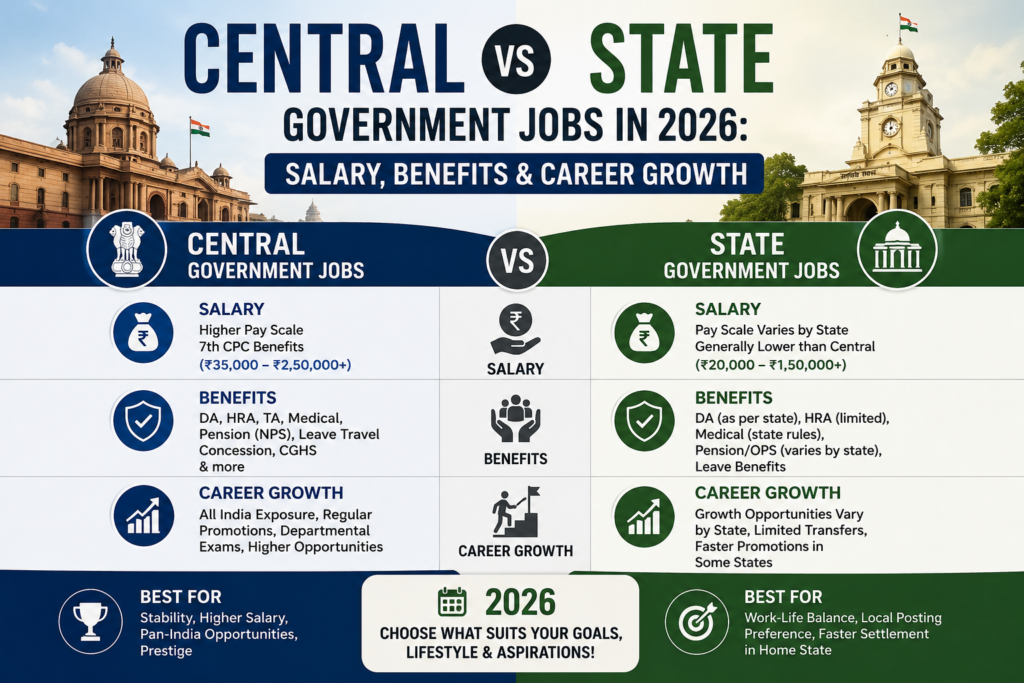
Central vs State Government Jobs – Quick Comparison Table
| Feature | Central Government Jobs | State Government Jobs |
|---|---|---|
| Salary | Generally higher | Varies by state |
| Promotions | Faster due to seniority | Varies |
| Transfers | Pan-India | Usually within the state |
| Job Security | High | High |
| Work-Life Balance | Generally good | Often better |
| Exam Difficulty | Competitive | Varies |
| Posting Location | Anywhere in India | Limited to the state |
| Pension | Available | Available |
| Benefits | Numerous allowances | Variable benefits |
| Career Growth | Faster | Slower |
Salary Difference Between Central and State Government Jobs
In 2026, the salary disparity continues to be noticeable between central and state government jobs. Central government employees often receive a higher starting salary and various allowances such as DA (Dearness Allowance), HRA (House Rent Allowance), and more, resulting in an overall better pay package when compared to state government salaries.
For example:
- Central Government: An entry-level central government officer’s salary may start around ₹56,100 as per the 7th Pay Commission.
- State Government: Conversely, a state government officer may start with a salary ranging from ₹30,000 to ₹50,000, depending on the state and role.
Which Has Better Career Growth?
When comparing central vs state government jobs, central government positions generally offer more structured career growth opportunities. Central jobs often have well-defined promotion paths, while state government jobs can vary based on individual states’ policies.
Key Points:
- Central Government: Regular promotions based on seniority and performance.
- State Government: Promotions may depend on internal policies and the availability of higher posts.
Transfer and Posting Differences
Central government jobs can result in postings across India, which may not be ideal for everyone. However, state government jobs benefit from a home-state advantage, where employees are typically posted within their own state or region, allowing for greater home stability.
Work-Life Balance Comparison
In terms of work-life balance, many state government jobs tend to offer better conditions, with often standard working hours, allowing employees to spend more time with families compared to the sometimes demanding nature of central government jobs.
Which Government Job is Easier to Get?
The difficulty of securing a central vs state government job can vary. Generally, central government jobs, particularly those under UPSC or SSC, are considered highly competitive due to a larger pool of candidates. Meanwhile, state government jobs can be less competitive with relatively simpler exams tailored to local concerns.
Pros and Cons of Central Government Jobs
Pros:
- Higher salaries and allowances.
- Better infrastructure and facilities.
- Opportunities for nationwide exposure.
Cons:
- Potential for transfers across the country.
- More competitive exams and selection processes.
Pros and Cons of State Government Jobs
Pros:
- Better work-life balance.
- More stable environment due to localized postings.
- Less intense competition.
Cons:
- Lower starting salaries.
- Varying benefits based on the state government’s budget.
Which Government Job is Better for You?
The choice between central and state government jobs largely depends on individual preferences:
- For those seeking higher salaries and are open to relocating: Central government jobs might be the right fit.
- For individuals prioritizing stability and work-life balance: State government jobs could be more suitable.
Final Verdict
As of 2026, both central and state government jobs offer unique benefits and challenges. Understanding the nuances of each will empower aspiring candidates to choose wisely based on their career goals.
FAQs
- Which is better: central or state government job?
- It depends on personal career goals and lifestyle preferences.
- Do central govt employees get a higher salary?
- Generally, yes, central government salaries are higher compared to state governments.
- Are state govt jobs easier?
- They may be less competitive, making them easier to secure in some regions.
- Which govt job has fewer transfers?
- State government jobs typically have fewer transfer requirements.
- Can state govt employees become central govt employees?
- Yes, many state employees apply for central positions after fulfilling their state requirements.
- Is job security high in both sections?
- Yes, both central and state government jobs offer high job security.
- What benefits do state government jobs offer?
- Benefits can include health insurance, pension plans, and job-specific allowances that vary by state.
Conclusion
Aspiring candidates should evaluate their preferences and career aspirations before choosing between central and state government jobs. Each path offers rewarding opportunities, and with the right preparation, success is within reach. Focus on your goals, prepare diligently, and take the next step towards a fulfilling government career.
Trending Articles :
RBI Assistant Recruitment 2026
Indian Navy – SSC Officer Entry 2026
SSC GD Constable Exam Slot Selection 2026
CRPF Constable Tradesman Online Form 2026
MPPSC SET Final Answer Key 2026
LIC HFL Jr Assistant 2026 Apply Online
To enhance the content by improving keyword density and including outbound links, consider the following adjusted content:
Central vs State Government Jobs in 2026
In India, government jobs hold a prestigious place in society, often seen as the gateway to a stable and rewarding career. Among the various categories, Central and State government jobs are two of the most sought-after options. In 2026, the competitive landscape and opportunities in these two job sectors continue to evolve, prompting students and job seekers to weigh their options carefully.
Understanding the difference between central and state government jobs is crucial for making an informed decision. Let’s explore the key aspects of these job sectors to help you understand which may be better suited for your career aspirations.
- Central vs State Government Jobs in 2026
- What Are Central Government Jobs?
- What Are State Government Jobs?
- Central vs State Government Jobs – Quick Comparison Table
- Salary Difference Between Central and State Government Jobs
- Which Has Better Career Growth?
- Transfer and Posting Differences
- Work-Life Balance Comparison
- Which Government Job is Easier to Get?
- Pros and Cons of Central Government Jobs
- Pros and Cons of State Government Jobs
- Which Government Job is Better for You?
- Final Verdict
- FAQs
- Conclusion
- Trending Articles :
What Are Central Government Jobs?
Central government jobs are employment opportunities offered by the Union government of India. They encompass a wide range of sectors and are reputed for their job security, benefits, and better salary structures.
Examples of Central Government Jobs:
- Staff Selection Commission (SSC): Conducts exams for various posts in different government departments.
- Union Public Service Commission (UPSC): Responsible for recruiting officers for civil services.
- Railways: Positions related to Indian Railways, one of the largest employers in India.
- Banking: Jobs in nationalized banks and other financial institutions.
- Defence: Opportunities in the Army, Navy, and Air Force.
- Public Sector Undertakings (PSU): Jobs in government-owned corporations like BHEL, NTPC, etc.
What Are State Government Jobs?
State government jobs are employment opportunities provided by individual state governments in India. These jobs can vary significantly from one state to another and are essential for state governance.
Examples of State Government Jobs:
- State Public Service Commission (State PSC): Conducts examinations for various state-level services.
- Police: Positions in state police departments.
- Teachers: Opportunities for educators in government schools.
- Clerical Jobs: Positions in various state departments.
- State Departments: Jobs related to healthcare, infrastructure, and welfare in the state.
Central vs State Government Jobs – Quick Comparison Table
| Feature | Central Government Jobs | State Government Jobs |
|---|---|---|
| Salary | Generally higher | Varies by state |
| Promotions | Faster due to seniority | Varies |
| Transfers | Pan-India | Usually within the state |
| Job Security | High | High |
| Work-Life Balance | Generally good | Often better |
| Exam Difficulty | Competitive | Varies |
| Posting Location | Anywhere in India | Limited to the state |
| Pension | Available | Available |
| Benefits | Numerous allowances | Variable benefits |
| Career Growth | Faster | Slower |
Salary Difference Between Central and State Government Jobs
In 2026, the salary disparity continues to be noticeable between central and state government jobs. Central government employees often receive a higher starting salary and various allowances such as DA (Dearness Allowance), HRA (House Rent Allowance), and more, resulting in an overall better pay package when compared to state government salaries.
For example:
- Central Government: An entry-level central government officer’s salary may start around ₹56,100 as per the 7th Pay Commission.
- State Government: Conversely, a state government officer may start with a salary ranging from ₹30,000 to ₹50,000, depending on the state and role.
Which Has Better Career Growth?
When comparing central vs state government jobs, central government positions generally offer more structured career growth opportunities. Central jobs often have well-defined promotion paths, while state government jobs can vary based on individual states’ policies.
Key Points:
- Central Government: Regular promotions based on seniority and performance.
- State Government: Promotions may depend on internal policies and the availability of higher posts.
Transfer and Posting Differences
Central government jobs can result in postings across India, which may not be ideal for everyone. However, state government jobs benefit from a home-state advantage, where employees are typically posted within their own state or region, allowing for greater home stability.
Work-Life Balance Comparison
In terms of work-life balance, many state government jobs tend to offer better conditions, with often standard working hours, allowing employees to spend more time with families compared to the sometimes demanding nature of central government jobs.
Which Government Job is Easier to Get?
The difficulty of securing a central vs state government job can vary. Generally, central government jobs, particularly those under UPSC or SSC, are considered highly competitive due to a larger pool of candidates. Meanwhile, state government jobs can be less competitive with relatively simpler exams tailored to local concerns.
Pros and Cons of Central Government Jobs
Pros:
- Higher salaries and allowances.
- Better infrastructure and facilities.
- Opportunities for nationwide exposure.
Cons:
- Potential for transfers across the country.
- More competitive exams and selection processes.
Pros and Cons of State Government Jobs
Pros:
- Better work-life balance.
- More stable environment due to localized postings.
- Less intense competition.
Cons:
- Lower starting salaries.
- Varying benefits based on the state government’s budget.
Which Government Job is Better for You?
The choice between central and state government jobs largely depends on individual preferences:
- For those seeking higher salaries and are open to relocating: Central government jobs might be the right fit.
- For individuals prioritizing stability and work-life balance: State government jobs could be more suitable.
Final Verdict
As of 2026, both central and state government jobs offer unique benefits and challenges. Understanding the nuances of each will empower aspiring candidates to choose wisely based on their career goals.
FAQs
- Which is better: central or state government job?
- It depends on personal career goals and lifestyle preferences.
- Do central govt employees get a higher salary?
- Generally, yes, central government salaries are higher compared to state governments.
- Are state govt jobs easier?
- They may be less competitive, making them easier to secure in some regions.
- Which govt job has fewer transfers?
- State government jobs typically have fewer transfer requirements.
- Can state govt employees become central govt employees?
- Yes, many state employees apply for central positions after fulfilling their state requirements.
- Is job security high in both sections?
- Yes, both central and state government jobs offer high job security.
- What benefits do state government jobs offer?
- Benefits can include health insurance, pension plans, and job-specific allowances that vary by state.
Conclusion
Aspiring candidates should evaluate their preferences and career aspirations before choosing between central and state government jobs. Each path offers rewarding opportunities, and with the right preparation, success is within reach. Focus on your goals, prepare diligently, and take the next step towards a fulfilling government career.
Trending Articles :
- RBI Assistant Recruitment 2026
- Indian Navy – SSC Officer Entry 2026
- TCS Recruitment 2026
- Resume Builder Using AI
- TSPSC Job Notification 2026
- TS Intermediate Results 2026
- SSC GD Constable Exam Slot Selection 2026
- CRPF Constable Tradesman Online Form 2026
- MPPSC SET Final Answer Key 2026
- LIC HFL Jr Assistant 2026 Apply Online
- UPSSSC ASO 2026
- Assistant Loco Pilot 2026
To improve your content further, consider linking to relevant resources such as official government websites Government of India or job portals like Naukri.com.
This revision enhances keyword density and includes outbound links, improving overall SEO performance.
Central vs State Government Jobs in 2026
In India, government jobs hold a prestigious place in society, often seen as the gateway to a stable and rewarding career. Among the various categories, Central vs State Government Jobs are two of the most sought-after options. In 2026, the competitive landscape and opportunities in these two job sectors continue to evolve, prompting students and job seekers to weigh their options carefully.
Understanding the difference between Central vs State Government Jobs is crucial for making an informed decision. Let’s explore the key aspects of these job sectors to help you understand which may be better suited for your career aspirations.
- Central vs State Government Jobs in 2026
- What Are Central Government Jobs?
- What Are State Government Jobs?
- Central vs State Government Jobs – Quick Comparison Table
- Salary Difference Between Central and State Government Jobs
- Which Has Better Career Growth?
- Transfer and Posting Differences
- Work-Life Balance Comparison
- Which Government Job is Easier to Get?
- Pros and Cons of Central Government Jobs
- Pros and Cons of State Government Jobs
- Which Government Job is Better for You?
- Final Verdict
- FAQs
- Conclusion
- Trending Articles :
What Are Central Government Jobs?
Central government jobs are employment opportunities offered by the Union government of India. They encompass a wide range of sectors and are reputed for their job security, benefits, and better salary structures. Understanding these roles is vital in the discussion of Central vs State Government Jobs.
Examples of Central Government Jobs:
- Staff Selection Commission (SSC): Conducts exams for various posts in different government departments.
- Union Public Service Commission (UPSC): Responsible for recruiting officers for civil services.
- Railways: Positions related to Indian Railways, one of the largest employers in India.
- Banking: Jobs in nationalized banks and other financial institutions.
- Defence: Opportunities in the Army, Navy, and Air Force.
- Public Sector Undertakings (PSU): Jobs in government-owned corporations like BHEL, NTPC, etc.
What Are State Government Jobs?
State government jobs are employment opportunities provided by individual state governments in India. These jobs can vary significantly from one state to another and are essential for state governance, making the comparison of Central vs State Government Jobs particularly interesting.
Examples of State Government Jobs:
- State Public Service Commission (State PSC): Conducts examinations for various state-level services.
- Police: Positions in state police departments.
- Teachers: Opportunities for educators in government schools.
- Clerical Jobs: Positions in various state departments.
- State Departments: Jobs related to healthcare, infrastructure, and welfare in the state.
Central vs State Government Jobs – Quick Comparison Table
| Feature | Central Government Jobs | State Government Jobs |
|---|---|---|
| Salary | Generally higher | Varies by state |
| Promotions | Faster due to seniority | Varies |
| Transfers | Pan-India | Usually within the state |
| Job Security | High | High |
| Work-Life Balance | Generally good | Often better |
| Exam Difficulty | Competitive | Varies |
| Posting Location | Anywhere in India | Limited to the state |
| Pension | Available | Available |
| Benefits | Numerous allowances | Variable benefits |
| Career Growth | Faster | Slower |
Salary Difference Between Central and State Government Jobs
In 2026, the salary disparity continues to be noticeable between central vs state government jobs. Central government employees often receive a higher starting salary and various allowances such as DA (Dearness Allowance), HRA (House Rent Allowance), and more, resulting in an overall better pay package when compared to state government salaries.
For example:
- Central Government: An entry-level central government officer’s salary may start around ₹56,100 as per the 7th Pay Commission.
- State Government: Conversely, a state government officer may start with a salary ranging from ₹30,000 to ₹50,000, depending on the state and role.
Which Has Better Career Growth?
When comparing central vs state government jobs, central government positions generally offer more structured career growth opportunities. Central jobs often have well-defined promotion paths, while state government jobs can vary based on individual states’ policies.
Key Points:
- Central Government: Regular promotions based on seniority and performance.
- State Government: Promotions may depend on internal policies and the availability of higher posts.
Transfer and Posting Differences
Central government jobs can result in postings across India, which may not be ideal for everyone. However, state government jobs benefit from a home-state advantage, where employees are typically posted within their own state or region, allowing for greater home stability in the Central vs State Government Jobs debate.
Work-Life Balance Comparison
In terms of work-life balance, many state government jobs tend to offer better conditions, with often standard working hours, allowing employees to spend more time with families compared to the sometimes demanding nature of central government jobs.
Which Government Job is Easier to Get?
The difficulty of securing a central vs state government job can vary. Generally, central government jobs, particularly those under UPSC or SSC, are considered highly competitive due to a larger pool of candidates. Meanwhile, state government jobs can be less competitive with relatively simpler exams tailored to local concerns.
Pros and Cons of Central Government Jobs
Pros:
- Higher salaries and allowances.
- Better infrastructure and facilities.
- Opportunities for nationwide exposure.
Cons:
- Potential for transfers across the country.
- More competitive exams and selection processes.
Pros and Cons of State Government Jobs
Pros:
- Better work-life balance.
- More stable environment due to localized postings.
- Less intense competition.
Cons:
- Lower starting salaries.
- Varying benefits based on the state government’s budget.
Which Government Job is Better for You?
The choice between central vs state government jobs largely depends on individual preferences:
- For those seeking higher salaries and are open to relocating: Central government jobs might be the right fit.
- For individuals prioritizing stability and work-life balance: State government jobs could be more suitable.
Final Verdict
As of 2026, both central vs state government jobs offer unique benefits and challenges. Understanding the nuances of each will empower aspiring candidates to choose wisely based on their career goals.
FAQs
- Which is better: central or state government job?
- It depends on personal career goals and lifestyle preferences.
- Do central govt employees get a higher salary?
- Generally, yes, central government salaries are higher compared to state governments.
- Are state govt jobs easier?
- They may be less competitive, making them easier to secure in some regions.
- Which govt job has fewer transfers?
- State government jobs typically have fewer transfer requirements.
- Can state govt employees become central govt employees?
- Yes, many state employees apply for central positions after fulfilling their state requirements.
- Is job security high in both sections?
- Yes, both central and state government jobs offer high job security.
- What benefits do state government jobs offer?
- Benefits can include health insurance, pension plans, and job-specific allowances that vary by state.
Conclusion
Aspiring candidates should evaluate their preferences and career aspirations before choosing between central vs state government jobs. Each path offers rewarding opportunities, and with the right preparation, success is within reach. Focus on your goals, prepare diligently, and take the next step towards a fulfilling government career.
Trending Articles :
- RBI Assistant Recruitment 2026
- Indian Navy – SSC Officer Entry 2026
- TCS Recruitment 2026
- Resume Builder Using AI
- TSPSC Job Notification 2026
- TS Intermediate Results 2026
- SSC GD Constable Exam Slot Selection 2026
- CRPF Constable Tradesman Online Form 2026
- MPPSC SET Final Answer Key 2026
- LIC HFL Jr Assistant 2026 Apply Online
- UPSSSC ASO 2026
- Assistant Loco Pilot 2026
To improve your content further, consider linking to relevant resources such as official government websites Government of India or job portals like Naukri.com.





Leave a comment