

The SSC MTS 2026 exam is one of the most popular government job exams in India for candidates who have completed their 10th standard. Every year, the Staff Selection Commission (SSC) conducts the Multi-Tasking Staff (MTS) examination to recruit candidates for various non-technical posts in central government departments.
Thank you for reading this post, don't forget to subscribe!If you are planning to appear for the SSC MTS 2026 exam, understanding the latest syllabus and exam pattern is extremely important. The syllabus provides a roadmap for your preparation and helps you focus on the right topics.
If you want complete details about vacancy, eligibility, and exam pattern, read our full guide: SSC MTS 2026 Notification
Table of Contents
SSC MTS Syllabus 2026: Exam Overview
The SSC MTS examination is conducted to recruit candidates for posts such as:
- Multi-Tasking Staff (MTS)
- Havaldar (CBIC & CBN)
These posts fall under Group-C Non-Gazetted, Non-Ministerial categories in various ministries and departments of the Government of India.
SSC MTS Syllabus 2026: Key Highlights
| Particulars | Details |
|---|---|
| Exam Name | SSC MTS 2026 |
| Conducting Authority | Staff Selection Commission |
| Qualification | 10th Pass |
| Selection Process | Computer Based Exam + Physical Test (Havaldar only) |
| Exam Mode | Online |
| Job Location | Across India |
| Official Website | ssc.gov.in |
SSC MTS Syllabus 2026: Selection Process
The selection process for SSC MTS 2026 consists of the following stages:
1. Computer Based Test (CBT)
The CBT exam consists of two sessions conducted on the same day.
2. Physical Efficiency Test (PET/PST)
This stage applies only to Havaldar posts.
Candidates applying for MTS posts only need to clear the CBT exam.
SSC MTS 2026 Exam Pattern
Understanding the exam pattern helps candidates prepare effectively.
The SSC MTS computer-based exam is divided into two sessions:
Session 1
| Subject | Questions | Marks |
|---|---|---|
| Numerical & Mathematical Ability | 20 | 60 |
| Reasoning Ability & Problem Solving | 20 | 60 |
| Total | 40 | 120 |
Important Points
- No negative marking
- Time: 45 minutes
Session 2
| Subject | Questions | Marks |
|---|---|---|
| General Awareness | 25 | 75 |
| English Language & Comprehension | 25 | 75 |
| Total | 50 | 150 |
Important Points
- Negative marking: 1 mark for wrong answer
- Time: 45 minutes
SSC MTS Syllabus 2026: Detailed Syllabus
Now let’s explore the subject-wise syllabus for SSC MTS 2026.
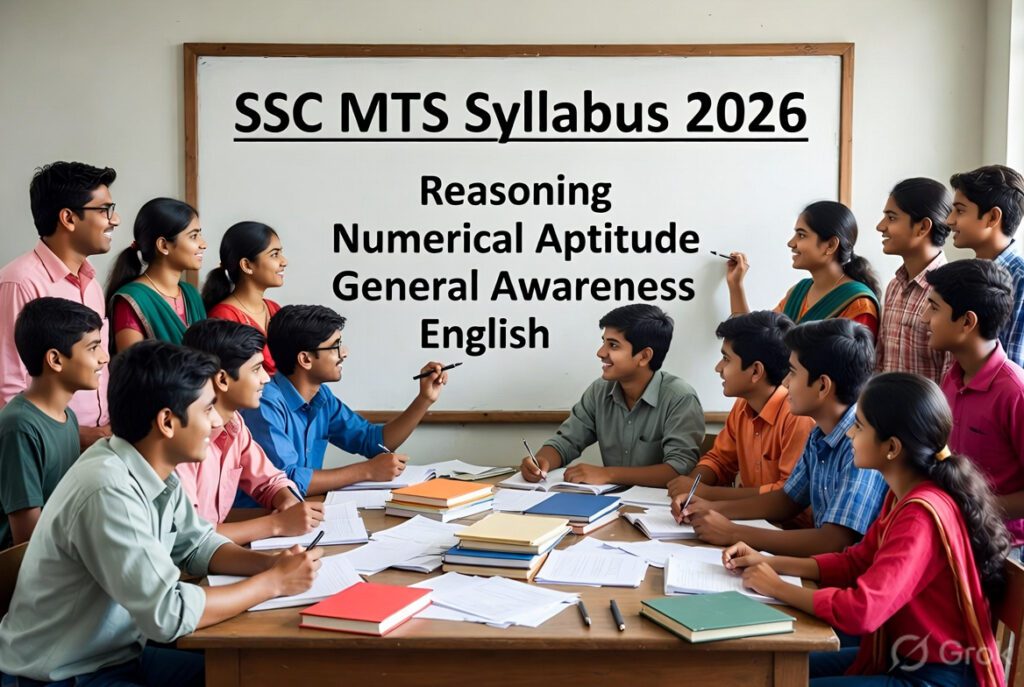
1. Numerical and Mathematical Ability Syllabus
This section tests the basic mathematical skills of candidates.
The difficulty level of this section is usually Class 10 standard.
Important Topics
- Number System
- Whole Numbers
- Decimals and Fractions
- Percentage
- Ratio and Proportion
- Average
- Profit and Loss
- Simple Interest
- Discount
- Time and Work
- Time, Speed and Distance
- Mensuration
- Geometry
- Algebra (basic level)
- Data Interpretation
- LCM and HCF
Preparation Tips
To score well in this section:
- Focus on basic concepts
- Practice daily calculations
- Solve previous year question papers
- Learn short tricks
Practicing mock tests regularly can significantly improve your speed.
For detailed salary structure, allowances, and in-hand salary, read our complete guide: SSC MTS Salary 2026
2. Reasoning Ability and Problem Solving
This section tests logical thinking and analytical ability.
Most questions are conceptual and pattern-based.
Important Topics
- Analogy
- Classification
- Coding-Decoding
- Series (Number & Alphabet)
- Blood Relations
- Direction Sense
- Venn Diagrams
- Puzzle
- Matrix
- Word Formation
- Odd One Out
- Syllogism
- Missing Number
- Non-verbal Reasoning
- Pattern Recognition
Preparation Tips
- Practice reasoning puzzles daily
- Improve logical thinking
- Solve previous SSC exam questions
Reasoning is one of the highest scoring sections if practiced properly.
If you want complete details about SSC MTS Selection Process 2026 read our full guide : SSC MTS Selection Process 2026
3. General Awareness Syllabus
This section evaluates the candidate’s knowledge of current events and general knowledge.
Unlike other subjects, this section cannot be solved with formulas, so consistent reading is important.
Important Topics
- Indian History
- Indian Geography
- Indian Polity
- Indian Economy
- Static General Knowledge
- Current Affairs
- Important Days
- Awards and Honors
- Books and Authors
- Sports
- Scientific Research
- Environment
- Government Schemes
Preparation Strategy
Candidates should:
- Read daily newspapers
- Follow monthly current affairs
- Study NCERT books
- Practice GK quizzes
Consistency is the key to scoring well in this section.
4. English Language and Comprehension
This section tests basic English grammar and understanding ability.
Questions are generally simple and scoring.
Important Topics
- Reading Comprehension
- Error Detection
- Fill in the Blanks
- Synonyms
- Antonyms
- Sentence Improvement
- One Word Substitution
- Idioms and Phrases
- Spelling Correction
- Sentence Rearrangement
Preparation Tips
- Improve basic grammar
- Read English newspapers
- Practice comprehension passages
Candidates who practice daily vocabulary exercises usually score high in this section.
If you want complete details about SSC MTS age limit read our full guide : ssc mts age limit 2026
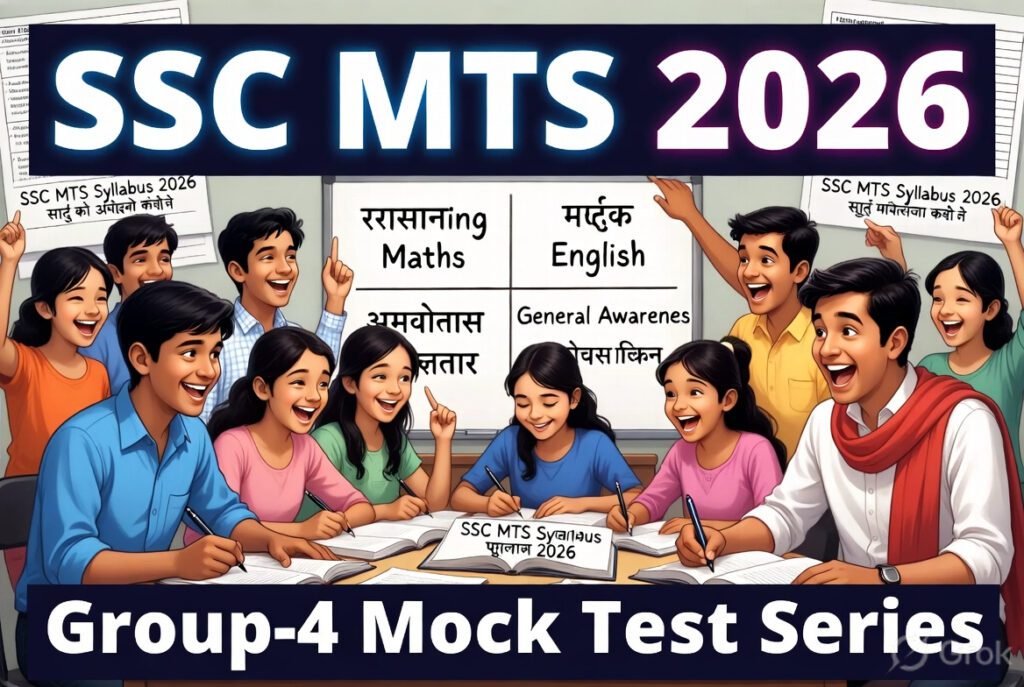
SSC MTS Havaldar Physical Test
Candidates applying for Havaldar posts must also clear the Physical Efficiency Test (PET).
Walking Test
| Gender | Distance | Time |
|---|---|---|
| Male | 1600 meters | 15 minutes |
| Female | 1 km | 20 minutes |
SSC MTS 2026 Preparation Strategy
Preparing for SSC MTS requires a smart study plan.
Here are some effective preparation strategies.
1. Understand the Syllabus First
Before starting preparation:
- Carefully analyze the complete syllabus
- Identify important topics
- Create a study timetable
2. Solve Previous Year Papers
Previous year papers help you understand:
- Question pattern
- Difficulty level
- Important topics
Candidates should solve at least 10 previous year papers.
3. Attempt Mock Tests
Mock tests help in:
- Improving speed
- Increasing accuracy
- Managing time
Try to take weekly mock tests.
4. Revise Regularly
Revision is essential to retain information.
Follow the 3-step revision rule:
- Weekly revision
- Monthly revision
- Final revision before exam
5. Focus on Weak Areas
Identify your weak subjects and dedicate extra time to them.
For example:
- If you struggle with math, practice daily problems.
- If English is weak, focus on grammar rules and vocabulary.
If you want complete details about SSC MTS Exam Pattern 2026 read our full guide : SSC MTS Exam Pattern 2026
SSC MTS Syllabus 2026 PDF Download
Many candidates prefer studying the syllabus in a downloadable PDF format so they can access it anytime while preparing for the exam. The SSC MTS Syllabus 2026 PDF contains the complete exam pattern, subject-wise topics, marking scheme, and other important instructions issued by the Staff Selection Commission.
Downloading the syllabus PDF helps candidates create a structured preparation plan and track the topics they have already completed.
Why You Should Download the SSC MTS Syllabus PDF
Having the syllabus in PDF format offers several benefits for exam preparation:
1. Easy Offline Access
You can study the syllabus even without an internet connection.
2. Better Study Planning
A downloaded syllabus helps you mark important topics and plan your daily study schedule.
3. Track Your Preparation
Candidates can highlight completed topics and focus more on weaker areas.
4. Quick Revision Before Exam
Before the exam, you can quickly review the entire syllabus in one document.
What Is Included in the SSC MTS Syllabus 2026 PDF
The official syllabus PDF usually includes the following details:
- Complete SSC MTS exam pattern
- Session 1 and Session 2 structure
- Subject-wise syllabus
- Marking scheme
- Negative marking details
- Instructions for candidates
- Physical test details for Havaldar posts
This document acts as the official preparation guide for the SSC MTS examination.
How to Download SSC MTS Syllabus 2026 PDF
Follow these simple steps to download the official syllabus PDF:
- Visit the official website of SSC: ssc.gov.in
- Go to the “Candidate’s Corner” or “Syllabus” section
- Find the link for SSC MTS Syllabus 2026
- Click on the PDF download option
- Save the file on your device for future reference
Candidates should always download the syllabus from the official SSC website to ensure the information is accurate and updated.
Direct SSC MTS Syllabus 2026 PDF Download Link
For the convenience of candidates, many education portals also provide a direct download link for the SSC MTS syllabus PDF. You can simply click the link below to access the syllabus document and start your preparation.
Download SSC MTS Syllabus 2026 PDF – Download SSC MTS Syllabus PDF
Make sure to keep the syllabus PDF saved on your mobile or laptop so that you can quickly review important topics anytime during your preparation.
Best Books for SSC MTS Preparation
Here are some recommended books for SSC MTS preparation.
Quantitative Aptitude
- Fast Track Arithmetic
- SSC Mathematics by Rakesh Yadav
Reasoning
- Analytical Reasoning by M.K. Pandey
- A Modern Approach to Verbal & Non-Verbal Reasoning
General Awareness
- Lucent General Knowledge
- Current Affairs Monthly Magazines
English
- Objective General English by S.P. Bakshi
- Word Power Made Easy
SSC MTS 2026 Expected Cut Off
The cut-off marks vary depending on:
- Number of candidates
- Difficulty level
- Category
Expected Cut Off Range
| Category | Expected Cut Off |
|---|---|
| General | 75-85 |
| OBC | 70-80 |
| SC | 65-75 |
| ST | 60-70 |
These are estimated values based on previous year trends.
SSC MTS Salary 2026
SSC MTS employees receive salary under Pay Level 1 of the 7th Pay Commission.
Salary Structure
| Component | Amount |
|---|---|
| Basic Pay | ₹18,000 |
| DA | ₹5,000 approx |
| HRA | ₹2,000 – ₹5,000 |
| Total Salary | ₹22,000 – ₹28,000 |
Employees also receive:
- Medical benefits
- Pension
- Government allowances
SSC MTS 2026 Preparation Timeline
Here is a recommended study timeline.
6 Months Preparation Plan
Month 1–2
Focus on basic concepts
Month 3–4
Practice advanced questions
Month 5
Solve previous papers
Month 6
Attempt full mock tests
This plan helps candidates stay organized and focused.
Frequently Asked Questions (FAQs)
Q1:Who is eligible for SSC MTS 2026?
For SSC MTS 2026, eligibility generally requires Indian citizenship (or subjects of Nepal/Bhutan), passing Matric (10th) by a cutoff date (around Aug 1, 2025), and being 18-25 years old for MTS (18-27 for Havaldar), with age relaxations for reserved categories, and no minimum percentage in 10th grade needed
Q2:What is the salary of SSC MTS in 2026?
The SSC MTS salary for 2026 follows the 7th Pay Commission at Pay Level-1, with a starting basic pay of ₹18,000 and a Grade Pay of ₹1,800, leading to an initial in-hand salary typically ranging from ₹18,000 to ₹22,000 per month, depending heavily on the city of posting (X, Y, or Z category) due to varying Dearness Allowance (DA), House Rent Allowance (HRA), and Transport Allowance (TA). Gross salary can reach ₹22,000–₹28,000 before deductions like NPS.
Q3:Is MTS paper 2 qualifying?
Yes, for the SSC MTS (Staff Selection Commission Multi Tasking Staff) exam, the Tier 2 (now Session II of the Computer Based Exam) is qualifying in nature, meaning you must pass it to be considered for final selection, but the merit list is based on Tier 1 (Session I) marks, subject to clearing Session II and Physical Tests (for Havaldar). The overall exam structure has changed, integrating everything into a single Computer Based Exam with compulsory Sessions I and II, where both have qualifying thresholds, and only those clearing Session I proceed to Session II evaluation
Q4:Is SSC MTS free for females?
Yes, female candidates are exempted from paying the application fee for the SSC MTS (Multi-Tasking Staff) exam; they do not have to pay the usual ₹100 fee required for General/OBC candidates, making it free for them. This fee exemption also applies to SC/ST, PwBD (Persons with Benchmark Disabilities), and Ex-servicemen.
Q5:Is MTS has two exams?
Yes, the SSC MTS exam (Staff Selection Commission Multi-Tasking Staff) has two sessions within a single Computer-Based Test (CBT) on the same day, which are mandatory, covering math/reasoning (Session 1) and general awareness/English (Session 2), plus a Physical Efficiency Test (PET)/Physical Standard Test (PST) for Havaldar posts. The final selection for MTS relies on marks from both CBT sessions, while Havaldar roles also require passing the PET/PST




9 Comments